Upon the premiere of Youssef Chahine’s Cairo at Cannes, the Egyptian critics in attendance resented its unflinching portrayal of the city’s poverty and density, claiming it as a derogatory and inciting the film’s eventual ban. In The Completely True Tales of Um Mimi and Sharawi the Adulterer, author and screenwriter Belal Fadl takes a similarly undaunted look at the capital: its swarming underbelly, its suffocating divides, and its unrelenting pressures that bloom both tragedy and absurdity. Written in a captivating style that listens carefully to the city’s manifold ranges, Fadl is determined to pull back the curtains, putting a middle finger up to politeness or grandeur, and drawing instead on chaos, comedy, and linguistic richness to portrait a Cairo full of adrenaline, be it from laughter, thrill, or the sheer will to survive.
Tag: literature
-

The Completely True Tales of Um Mimi and Sharawi the Adulterer
On the way to Um Mimi!
Whenever I tell my story, I say that what led me to live with Um Mimi were two Polish breasts with unparalleled nipples. I saw them in an R-rated movie on a winter’s night that started beautifully, then turned gloomy. Although this wasn’t exactly what happened, it’s not too far from the truth.
At the time, I thought the hands of fate hadn’t been kind to me when—among all the rooms and flats, both furnished and empty, in all of Cairo’s alleys and streets—it chose for me a room without a door in a flat without a soul, where I would live with a keyed-up woman. But sometimes, it takes twenty-five years to realize that life did you a favour when it selected you to live its most absurd experience.
My story started in the fall of 1991. My grades in high school had qualified me to study in the faculty of mass communications at Cairo University. For those who don’t already know, this meant I had to fill out a form called the ‘Application of Wishes’—a poetic name that is in no way relevant to its contents. All you do is plug in the departments where you want to study in order, according to your grades, so that the coordination office can choose an available program. This is done according to a process, the inner workings of which no one knows save the employees of the Ministry of Higher Education; it’s a process that no one doubts, in order to avoid giving themselves a headache.Read the first chapter for free: The Completely True Tales of Um Mimi and Sharawi the Adulterer
-
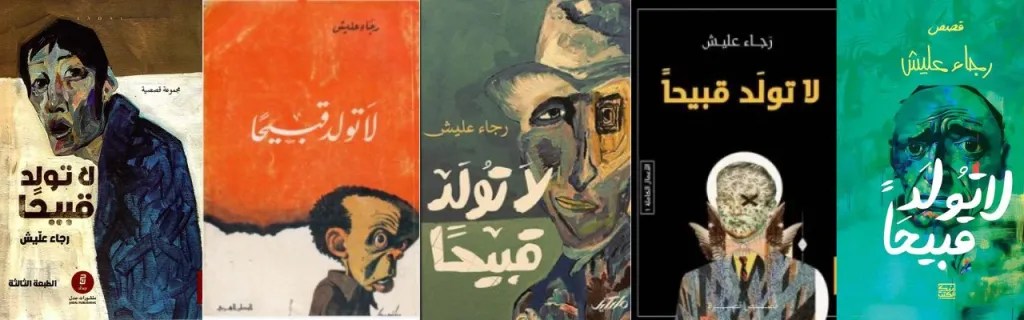
Don’t Be Born Ugly
By Ragaa Elish
Translated by Osama Hammad
Preface
These pages are about the strangest problem in my life: ugliness. Imagine the weirdest man on earth, the ugliest face you might ever encounter. Be certain that’s me; the forever laughingstock, the forever weird. I’m always the weirdest, the most horrendous, the ugliest.
Ugliness is the notion that dominates my life and feelings. It’s where I start and where I end; it’s the station from where I depart and to which I arrive. Ugliness is the grimy ash that has collected over all the particles, aesthetics, and pleasures in my life, tinting everything a bleak gray. It’s the dark light that beams over every corner of my life, forbidding me from having a transparent, clear sight of things and people.
In these pages, I’ll try to analyze the phenomenon of ugliness as I lived it, since no one has lived ugliness the way I did—no one has felt how horrible and bloody it was like I did.
Ugliness is like a transparent prism of glass; it has multiple surfaces and angles. I’ll try to present a comprehensive panoramic view for each surface and angle of that astounding prism beaming black light in every direction through my life, completely poisoning it and destroying its aesthetics.
Continue reading: Ragaa Elish: ‘Don’t Be Born Ugly’
-
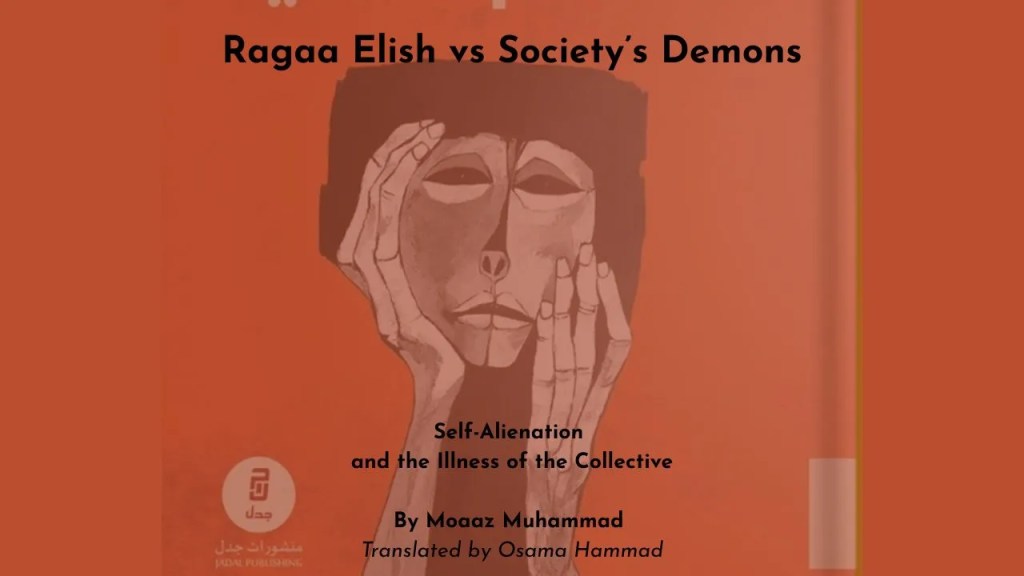
Ragaa Elish vs Society’s Demons:
Self-Alienation and the Illness of the Collective
By Moaaz Muhammad
Translated by Osama Hammad
Ragaa Elish (1932-1979) believed that his ugliness was what pushed people to deny him their sympathy. Because this virtue, as he thought, was only performed toward a beautiful person.
At the beginning of 1955, Erich Fromm published The Sane Society, where he discussed various notions and questions about the healthy society and the sick one, the sane individual and the mad one, and the types of individuals our modern societies produced. Although Fromm discussed western societies exclusively, his analysis crossed borders to describe humans amid capitalism and consumerism.
Fromm described his goal in writing this book as a continuation of what Sigmund Freud started in Civilization and its Discontents, which is about how culture and civilization clash with the needs of the individual and their psychological build. Freud wondered if someday someone would take the risk of exploring health conditions in civilized societies, which Fromm did, questioning how successful a civilization was in fulfilling the deep needs of the individual.
We all think that we were born in societies that have privileges our ancestors never had—which might be true, at least in part—but we brush off the mental and social taxes we pay, which our ancestors evaded. And while the people of the world now claim they are closer than ever to each other through the miracle of technology, instant communication, travel and trade, they seem to be more alienated than free—more than at any other time. The irony is that the more a society advanced economically and rose up in the modernity ladder, the more an existential anxiety and alienation erupted like a volcano, as if it were a curse.
Continue reading: Ragaa Elish vs Society’s Demons
 OSAMA TRANSLATES